
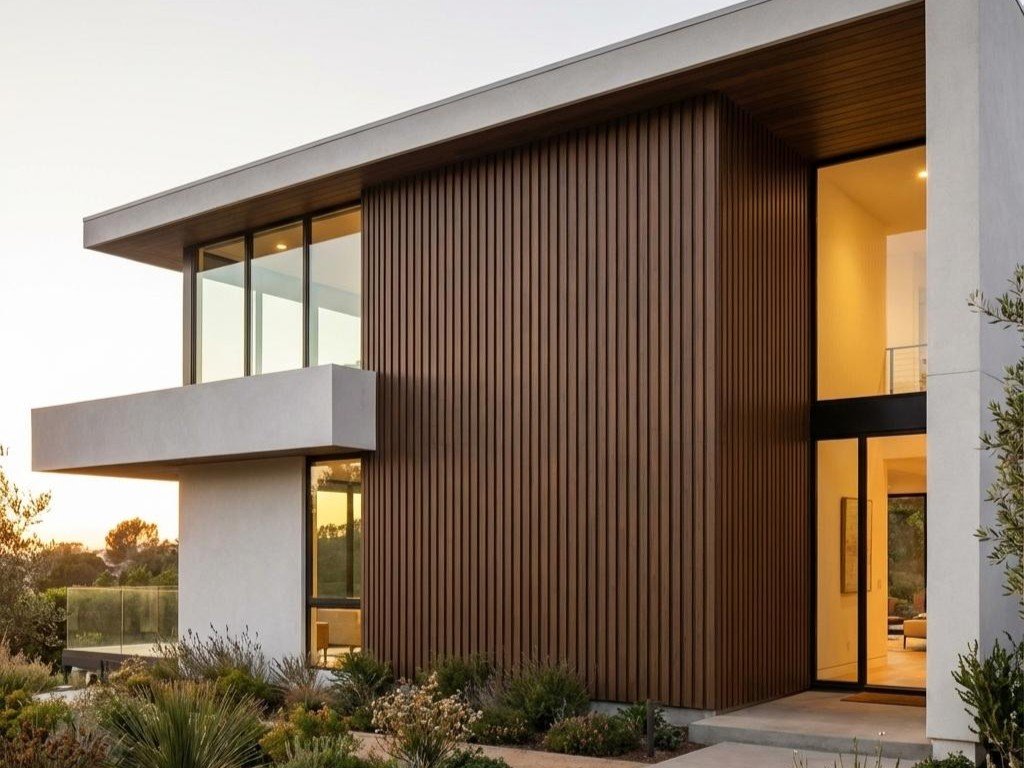
Introduction: Choosing the Best Exterior Wall Cladding for GCC Weather
Selecting the best exterior wall cladding materials for hot climates in the GCC requires careful consideration of temperature fluctuations, intense sunlight, UV radiation, humidity, dust, and occasional heavy rainfall. Across the United Arab Emirates (UAE) and Oman, exterior building materials must withstand demanding outdoor conditions while maintaining their appearance, structural stability, and long-term performance.
At Timber Mart Oman & UAE, we supply premium architectural cladding solutions designed for modern villas, commercial buildings, residential developments, hospitality projects, and high-rise façades. Our exterior wall cladding systems combine contemporary aesthetics with material technologies intended to support durability, weather resistance, and long-term colour retention.
Among the available options, ASA exterior wall cladding offers an attractive solution for projects that require a sophisticated architectural finish alongside enhanced resistance to sunlight and outdoor exposure. Its advanced outer layer is designed to improve UV stability and help maintain the appearance of exterior surfaces in demanding climates.
Whether you are planning a luxury villa in Dubai, a contemporary residence in Abu Dhabi, a commercial development in Sharjah, or an architectural project in Muscat, selecting the right exterior cladding system can make a significant difference to the building’s overall appearance and maintenance requirements.
1. What Is the Best Exterior Wall Cladding Material for Hot Climates?
The best exterior wall cladding material depends on the building design, environmental exposure, maintenance expectations, fire-safety requirements, and project budget. In the GCC, materials must be selected with particular attention to intense solar radiation, high surface temperatures, airborne dust, coastal humidity, and the expansion and contraction that can occur as temperatures change.
Common exterior cladding options include:
-
ASA exterior wall cladding: Designed to provide enhanced UV stability, weather resistance, and long-term colour retention.
-
Wood-plastic composite (WPC) cladding: Combines wood-based components and polymers to create decorative exterior surfaces.
-
Fibre cement cladding: Offers a rigid façade solution when appropriately specified and installed.
-
Aluminium cladding: Provides a lightweight architectural finish with a wide range of design possibilities.
-
Natural stone cladding: Creates a distinctive premium appearance but requires careful consideration of weight, anchoring, and installation.
-
Porcelain and ceramic façade systems: Offer a variety of finishes and can be suitable for exterior applications when installed using an appropriate façade system.
For projects where a contemporary wood-grain appearance, reduced maintenance requirements, and improved resistance to sunlight are priorities, ASA exterior cladding is worth considering.
At Timber Mart, we focus on supplying architectural cladding solutions that balance appearance, practical performance, and suitability for demanding outdoor environments in Oman and the UAE.
2. Why ASA Exterior Wall Cladding Is Suitable for GCC Conditions
Advanced ASA Outer Layer for UV Resistance
ASA stands for Acrylonitrile Styrene Acrylate, a thermoplastic material known for its weatherability and resistance to outdoor exposure. In exterior cladding applications, an ASA outer layer can help protect the visible surface against the effects of sunlight and weathering.
In the UAE and Oman, exterior façades may receive direct sunlight for extended periods. Prolonged UV exposure can contribute to fading, surface degradation, and changes in appearance in materials that are not designed for outdoor use.
An appropriately formulated ASA surface helps improve resistance to these effects, supporting a more consistent architectural finish over time.
For villas, hotels, commercial properties, and other developments where the façade is a prominent design feature, UV-stable exterior cladding can help preserve the intended appearance of the building.
Superior Colour Retention and Reduced Chalking
Colour stability is an important consideration when choosing exterior wall panels for hot climates. Dark colours, wood-grain finishes, and large uninterrupted façade surfaces can make visible changes in colour particularly noticeable.
Timber Mart’s ASA cladding specification highlights superior UV stability and resistance to fading and chalking. These characteristics are relevant to projects that require a consistent exterior appearance under prolonged outdoor exposure.
Actual colour retention depends on the product formulation, colour selection, installation conditions, and environmental exposure. Selecting a system tested for exterior weathering is therefore an important step when specifying cladding for GCC projects.
Resistance to Heat and Weather Exposure
Exterior cladding in the GCC must cope with high ambient temperatures, hot façade surfaces, dust, humidity, and occasional rainfall. Materials may also experience temperature-related expansion and contraction.
Our specified ASA exterior cladding system is designed for demanding outdoor applications, with an emphasis on heat resistance, weather resistance, and surface stability.
Correct installation is equally important. Suitable fixing methods, expansion allowances, joint details, and substrate preparation help accommodate temperature changes and support the long-term performance of the façade.
Lightweight Construction for Architectural Applications
Weight is an important factor when selecting a cladding system, particularly for high-rise façades, multi-storey residential buildings, and large commercial developments.
Lightweight exterior wall cladding can help reduce the additional dead load associated with a façade finish compared with heavier alternatives, depending on the complete system being replaced.
The actual suitability of a panel depends on its dimensions, density, support structure, fixing arrangement, wind loads, and the building’s design requirements. For high-rise applications, the complete façade assembly must be evaluated by the relevant design professionals.
At Timber Mart, we position lightweight ASA cladding as a solution for architectural projects where appearance, practical handling, and façade performance must work together.
3. Premium Architectural-Grade ASA Wall Cladding from Timber Mart

Our premium architectural-grade ASA wall cladding is designed for exterior applications that demand a refined finish and resistance to challenging outdoor conditions.
The specified system combines a wood-composite core with an advanced ASA outer layer. This construction aims to balance the visual appeal of decorative cladding with material characteristics suitable for exterior architectural use.
Key product characteristics include:
-
Lightweight construction for appropriate architectural applications.
-
Premium wood-grain finishes for contemporary façade designs.
-
High-performance ASA outer layer designed for enhanced weatherability.
-
Improved UV stability to help resist fading and chalking.
-
Heat and weather resistance for demanding outdoor environments.
-
Chemical resistance as specified for the product formulation.
-
Long-term colour retention under suitable application conditions.
-
Low water absorption, with a reported value of 0.90% for the specified product.
-
Designed for outdoor environments, including appropriate high-rise façade applications subject to project-specific engineering and approvals.
These characteristics make ASA cladding a potential option for modern residential and commercial developments across the GCC.
However, product specifications should always be reviewed alongside the intended application. Water absorption results, fire classifications, weathering performance, and other test results apply to the tested product and test conditions; they should not automatically be interpreted as guarantees for every installation or environmental condition.
4. Technical Specifications of ASA Exterior Wall Cladding
When selecting exterior wall cladding, architects, contractors, consultants, and property developers should examine technical documentation rather than relying solely on appearance.
The following table summarises the supplied specification details for Timber Mart’s ASA exterior cladding system.
| Specification | Supplied product information |
|---|---|
| Product type | Architectural-grade ASA exterior wall cladding |
| Surface layer | Acrylonitrile Styrene Acrylate (ASA) |
| Core material | Wood-composite core |
| Construction features | Mesh-net polymer and compatibilizer system |
| Weight consideration | Lightweight cladding construction |
| UV performance | Enhanced UV stability; resistance to fading and chalking |
| Environmental performance | Designed for demanding exterior environments |
| Water absorption | 0.90% reported |
| Weathering reference | ASTM D2244-23 and ASTM G154-23 |
| Reported weathering result | Grey scale 3–4 |
| Fire-performance reference | EN 13501-1 and ASTM E162-22 |
| Reported fire classification | Class B, as supplied; confirm the applicable test report and classification |
| Compliance references | REACH and RoHS reported as passed |
| Intended applications | Exterior façades and architectural cladding projects, subject to system approval |
Important technical note: The standards and results above reflect the supplied product information. Before specification or installation, request the relevant test reports and confirm the exact product, standard edition, test method, classification, and applicable installation conditions. ASTM E162 results and EN 13501-1 classifications are different forms of fire-performance assessment and should not be treated as interchangeable.
Understanding the Reported 0.90% Water Absorption
The specified ASA cladding has a reported water absorption value of 0.90%. Water absorption is relevant because moisture uptake can influence the dimensional stability and performance of certain composite materials.
However, the result should be interpreted according to the test method, specimen preparation, exposure duration, and measurement conditions used.
Low water absorption alone does not establish that an entire façade is waterproof. Joints, fasteners, penetrations, drainage provisions, and the substrate all influence the moisture performance of a completed cladding system.
For buildings in coastal Oman and the UAE, proper detailing remains essential even when the selected panels demonstrate favourable water absorption results.
Understanding the Weathering Test Results
The supplied specification references ASTM D2244-23 and ASTM G154-23, with a reported grey-scale rating of 3–4.
ASTM D2244 provides a method for calculating colour differences from measured colour coordinates. ASTM G154 addresses the use of fluorescent UV lamps to expose non-metallic materials to accelerated weathering conditions.
These methods provide useful information when evaluating exterior materials, but they serve different purposes. A grey-scale result should be interpreted alongside the actual test report, exposure duration, colour measurements, and the acceptance criteria used.
Accelerated weathering tests can help compare performance under controlled conditions, but they do not directly establish a specific number of years of service life in the UAE or Oman.
5. Advanced Composite Core Technology for Improved Stability
The performance of exterior composite cladding depends not only on its visible surface but also on the structure and formulation of its core.
The supplied Timber Mart product specification identifies a wood-composite core combined with a mesh-net polymer and compatibilizer system. It also describes a physically cross-linked structure, a mechano-tuned formulation, a stiffness-matched composition, and shear-thinning behaviour during processing.
These technical features relate to the material’s internal structure, bonding, processing behaviour, and potential mechanical performance.
Wood-Composite Core and Polymer Compatibility
Wood-composite materials combine wood-based components with polymeric materials. The final properties depend on the composition, manufacturing process, additives, and quality control.
A compatibilizer system may be used to improve interactions between otherwise different material components. Appropriate compatibility can support more consistent material properties and processing.
The mesh-net polymer component identified in the supplied specification forms part of the described composite construction. Its actual contribution to reinforcement, bonding, and dimensional stability should be evaluated using the manufacturer’s technical documentation and relevant test results.
Physically Cross-Linked Structure
The specification describes a physically cross-linked structure intended to enhance bonding and stability.
In polymer and composite systems, physical interactions between material components can influence cohesion, stiffness, and resistance to deformation. The exact behaviour depends on the polymer chemistry and manufacturing method.
For façade applications, the important practical considerations include dimensional stability, fixing strength, resistance to temperature-related movement, and consistency between production batches.
Stiffness-Matched Composition and Structural Integrity
A stiffness-matched composition is intended to balance the mechanical characteristics of the material’s components.
For exterior wall cladding, suitable stiffness helps the panel retain its intended shape under appropriate loading conditions. However, stiffness alone does not establish the panel’s load-bearing capacity, wind resistance, impact resistance, or suitability for a particular building height.
These factors must be evaluated through product testing and project-specific façade design.
Shear-Thinning Behaviour and Manufacturing Consistency
Shear-thinning behaviour describes a material whose apparent viscosity decreases as the applied shear rate increases. In polymer processing, this behaviour can influence how a formulation flows through manufacturing equipment.
For extrusion-based products, appropriate flow behaviour may help support consistent processing and production quality.
The actual impact on panel quality depends on the complete formulation, processing conditions, and manufacturing controls. For customers, consistency in dimensions, finish, and material properties remains an important consideration when purchasing cladding for large projects.
6. Best Exterior Wall Cladding Finishes for Modern Villas in the UAE and Oman
Exterior wall cladding plays an important role in defining a building’s architectural character. In the GCC, contemporary projects frequently combine clean lines, neutral colours, contrasting textures, and carefully positioned façade features.
Wood-Grain Exterior Wall Cladding
Wood-grain finishes can introduce warmth and texture to modern buildings without requiring natural timber across the entire exterior façade.
ASA wood-grain cladding is particularly relevant to projects seeking a premium decorative appearance alongside improved resistance to outdoor weathering.
It can be considered for selected façade sections, entrance features, boundary walls, architectural accents, and other suitable applications.
The selected finish should complement the building’s exterior paint, glazing, metalwork, landscaping, and surrounding architectural materials.
Contemporary Villa Façades
Luxury villas in Dubai, Abu Dhabi, Sharjah, and other Emirates often incorporate contrasting façade materials to create depth and visual interest.
Cladding can be used to highlight entrance walls, upper-storey features, recessed elevations, and selected architectural elements.
In Oman, similar approaches can enhance contemporary villas in Muscat and other developing residential areas.
The most successful designs combine appropriate material selection with careful detailing. Panel alignment, joint consistency, corner finishing, and fixing concealment can all influence the quality of the final appearance.
Commercial and High-Rise Buildings
Commercial developments and high-rise buildings require additional attention to wind loading, façade movement, fire performance, access for maintenance, and the requirements of local authorities.
Lightweight exterior cladding can be beneficial where the design calls for a decorative façade finish without the weight of some traditional materials.
Nevertheless, high-rise use must be supported by the necessary engineering calculations, tested fixing arrangements, fire documentation, and project approvals. A product’s intended suitability for high-rise façades does not replace the need for approval of the complete façade assembly.
7. ASA Cladding vs WPC, Aluminium, Fibre Cement and Natural Stone
Choosing between exterior wall cladding materials involves comparing their appearance, weight, maintenance requirements, weathering performance, installation methods, and cost.
| Material | Main advantages | Important considerations |
|---|---|---|
| ASA exterior cladding | UV-stable surface options, decorative finishes, weatherability | Verify fire classification, movement allowances, test reports, and system approvals |
| Conventional WPC cladding | Composite construction and a range of decorative finishes | Heat movement, moisture performance, UV resistance, and formulation vary by product |
| Aluminium cladding | Lightweight options, versatile finishes, and corrosion-resistant alloys | Coating quality, corrosion exposure, fixing design, and fire requirements |
| Fibre cement | Rigid façade panels and varied surface finishes | Weight, edge detailing, cutting requirements, and fixing systems |
| Natural stone | Distinctive natural appearance and substantial material character | Higher weight, anchoring design, substrate capacity, and installation complexity |
| Porcelain façade panels | Wide choice of colours and textures, with suitable products offering low water absorption | Brittle behaviour, fixing systems, wind loading, and panel handling |
No single material is the best choice for every project.
For a villa that requires a contemporary wood-grain appearance and an exterior surface designed for prolonged sunlight exposure, ASA cladding may be a suitable option.
For projects prioritising metallic finishes, aluminium may be preferable. Natural stone can suit designs seeking a traditional or substantial appearance, while fibre cement and porcelain may meet other architectural or technical requirements.
At Timber Mart Oman & UAE, we encourage customers to match the material to the building’s actual requirements instead of choosing a cladding system based on appearance alone.
8. How to Choose Exterior Wall Cladding for the UAE’s Hot Weather
When specifying exterior wall cladding in the UAE, consider the following factors before finalising the material.
UV Resistance and Colour Stability
Confirm that the product is designed for exterior exposure and request relevant accelerated weathering reports. If the building uses dark colours or prominent wood-grain finishes, examine the manufacturer’s guidance for long-term colour retention.
Thermal Expansion and Installation Gaps
Exterior panels expand and contract as temperatures change. Incorrect fixing methods or insufficient movement allowances may contribute to buckling, joint problems, or surface distortion.
Use the manufacturer’s installation instructions to determine appropriate expansion gaps, fixing positions, support spacing, and joint details.
Humidity and Coastal Conditions
Buildings near the coast may experience humid air and airborne salt. The suitability of fasteners, support structures, coatings, and other components should therefore be assessed for the exposure conditions.
A cladding panel’s weather resistance does not automatically guarantee that every associated fixing or support component will resist corrosion.
Fire Safety and Regulatory Compliance
Fire performance is a critical consideration for residential towers, commercial developments, and other buildings subject to specific façade regulations.
Review the applicable fire classification, test reports, system configuration, and local authority requirements before approving a product.
Do not assume that a material is suitable for a high-rise project solely because it has been described as fire retardant.
Maintenance and Accessibility
Even durable cladding requires appropriate inspection and cleaning. Dust, airborne pollutants, and environmental deposits can accumulate on exterior surfaces.
Choose a finish that can be maintained using the manufacturer’s recommended cleaning methods. For tall buildings, also consider safe access for periodic inspections and maintenance.
9. Choosing Exterior Wall Cladding for Oman’s Climate
Oman’s climate varies between coastal areas, inland locations, and elevated regions. Muscat and other coastal locations may experience high temperatures, humidity, salt exposure, and seasonal rainfall, while inland environments can experience substantial heat and dust.
These differences make product selection and installation planning especially important.
Exterior Cladding in Muscat
For residential and commercial developments in Muscat, exterior cladding should be selected with attention to solar exposure, moisture management, fixing durability, and the building’s architectural design.
Wood-grain ASA panels can be considered for modern villas and selected commercial façades where a refined decorative appearance is required.
For coastal buildings, suitable fasteners and support components should be selected according to the actual environmental exposure.
Exterior Cladding for Villas and Residential Projects
Villa owners often want exterior finishes that enhance the property’s appearance without creating excessive maintenance demands.
Decorative cladding can be used to distinguish entrance areas, boundary walls, balconies, and selected façade sections.
A well-designed installation should also include appropriate joint details, drainage provisions, and access for inspection where required.
Commercial Façades and Large Developments
For larger projects, product consistency, technical documentation, supply coordination, and installation planning become increasingly important.
Architects and contractors should review panel dimensions, available finishes, fixing specifications, fire documentation, and relevant weathering reports before placing an order.
Timber Mart Oman & UAE supplies cladding solutions for customers seeking contemporary architectural finishes for residential and commercial applications.
10. Is ASA Exterior Wall Cladding a Long-Term Investment?
Exterior cladding is an investment in a building’s appearance and envelope. Its long-term value depends on the initial product quality, installation workmanship, maintenance requirements, and suitability for the environment.
An exterior material that maintains its appearance under sunlight and weather exposure may reduce the need for premature surface replacement or refinishing. However, actual service life varies according to the product specification, installation, environmental conditions, and maintenance practices.
Potential Maintenance Benefits
ASA cladding with an appropriately formulated UV-resistant surface may help reduce problems associated with premature fading and chalking.
Its maintenance requirements should still be assessed using the manufacturer’s instructions. Regular inspection, suitable cleaning, and prompt attention to damaged panels or joints can help preserve the installation.
Architectural Value
A consistent façade finish can contribute to the overall appearance of a villa or commercial property. Wood-grain textures and contemporary panel designs provide opportunities to create visual contrast without relying exclusively on natural timber.
The final result depends on material quality, colour selection, panel layout, and installation accuracy.
Performance-Based Material Selection
A long-term investment decision should consider more than the purchase price. Relevant factors include:
-
Initial material and installation costs.
-
Expected maintenance requirements.
-
Replacement and repair accessibility.
-
Weathering and colour-retention performance.
-
Fire and regulatory compliance.
-
Availability of compatible accessories and replacement panels.
-
Suitability for the building’s location and intended use.
By evaluating these factors, property owners, architects, and contractors can make a more informed decision about the most suitable exterior wall cladding system.
11. Exterior Wall Cladding Applications for Villas, Commercial Buildings and High-Rise Façades
Luxury Villa Exterior Walls
For luxury villas, exterior wall cladding can introduce texture and contrast to otherwise plain surfaces. ASA wood-grain finishes may complement modern entrance designs, contemporary elevations, and selected architectural features.
The choice of finish should consider the surrounding materials and the amount of direct sunlight received by each façade.
Boundary Walls and Entrance Features
Boundary walls and entrance features are highly visible parts of residential properties. Decorative cladding can create a more coordinated appearance between the main building, entrance gate, and surrounding landscape.
Before installation, the substrate must be suitable for the selected fixing method, with appropriate provisions for moisture and movement.
Hospitality and Commercial Properties
Hotels, offices, retail developments, and hospitality buildings often require exterior materials that combine a premium appearance with manageable maintenance requirements.
ASA cladding can be evaluated for suitable decorative applications where its tested performance meets the project’s technical and regulatory requirements.
High-Rise Façade Applications
High-rise projects require a more detailed assessment than ordinary decorative wall applications. Wind loads, fire performance, panel retention, cavity design, building movement, and access for maintenance must all be considered.
The entire façade assembly, including the panels, brackets, fixings, insulation, cavity barriers, and substrate, must satisfy the applicable project requirements.
Timber Mart’s cladding specification identifies high-rise façades among the intended application environments, but project-specific approval and verification of the complete system remain essential.
12. Fire Performance, REACH and RoHS Compliance Considerations
Safety and compliance documentation should form part of the material-selection process for exterior cladding.
The supplied product information references EN 13501-1, ASTM E162-22, REACH, and RoHS. These references address different aspects of testing or regulatory compliance and must be interpreted according to the relevant documentation.
Fire-Retardant Performance
The specification describes the product as fire retardant and references EN 13501-1 and ASTM E162-22, with a stated Class B result.
EN 13501-1 provides a European classification framework for the reaction-to-fire performance of construction products. ASTM E162 is a separate test method that evaluates the surface flammability of materials using a radiant heat energy source.
These standards are not interchangeable. The exact classification, supporting report, test specimen, product construction, and applicable conditions must be confirmed before making a project compliance decision.
For façade systems, the fire performance of the complete assembly may differ from that of an individual panel. Local building regulations and authority requirements should always be followed.
REACH and RoHS
REACH is a European Union regulatory framework concerned with chemicals and their safe use. RoHS restricts certain hazardous substances in electrical and electronic equipment.
The supplied specification reports that the product has passed REACH and RoHS-related requirements. Customers should request the relevant declarations, certificates, and test documentation to confirm the exact scope of these claims and their applicability to the product being supplied.
Compliance claims should be supported by current, product-specific documentation rather than inferred from the material category alone.
13. Exterior Wall Cladding Installation: What Contractors Should Consider
Even a high-performance exterior cladding material can underperform when installed incorrectly. Proper planning is essential for maintaining panel alignment, weather resistance, and long-term stability.
Substrate Preparation
The supporting wall or substructure must be appropriate for the cladding system. Its condition, alignment, moisture exposure, and ability to accommodate the specified fixings should be checked before installation.
Support Structure and Fixings
The spacing and arrangement of supports should follow the manufacturer’s instructions and the project’s engineering requirements.
Fixings must be compatible with the panel material, support structure, and environmental exposure. Wind loading and the building’s height can affect the required design.
Panel Alignment and Joint Details
Consistent panel alignment contributes to the finished appearance of the façade. Joints, corners, edges, and transitions should be detailed carefully to accommodate movement and manage water.
Thermal Movement
In hot climates, thermal movement should be considered from the beginning of the design process. Incorrectly constrained panels may experience deformation or stress.
The installation team should follow the manufacturer’s specified allowances for expansion, contraction, and fixing.
Inspection and Maintenance
After installation, inspect the façade for alignment, secure fixings, finished edges, and properly completed joints. Periodic maintenance should follow the product manufacturer’s recommendations.
For high-rise and other regulated projects, installation and inspection should be carried out by appropriately qualified professionals in accordance with the approved façade design.
14. Why Choose Timber Mart for Exterior Wall Cladding in Oman and the UAE?
At Timber Mart Oman & UAE, we focus on supplying architectural products for modern residential and commercial projects. Our exterior cladding offering is intended for customers who value contemporary design, product specifications, and suitability for challenging regional weather conditions.
We understand that architects, contractors, traders, and property owners need more than an attractive surface. They also need reliable product information, appropriate material options, and a clear understanding of the system’s intended applications.
Our ASA exterior cladding specification highlights several important characteristics:
-
Premium architectural appearance with advanced wood-grain finishes.
-
Lightweight construction for appropriate façade applications.
-
Enhanced UV stability to help resist fading and chalking.
-
Weather and heat resistance for demanding outdoor environments.
-
Reported water absorption of 0.90% for the specified product.
-
Composite core technology designed around material compatibility and processing performance.
-
Technical test references that can be reviewed when evaluating product suitability.
We support customers seeking exterior cladding for villas, residential developments, commercial properties, and architectural projects across the UAE and Oman.
Our objective is to help customers identify a suitable cladding solution based on the intended application, appearance requirements, environmental exposure, and technical specifications.
15. Where to Buy Premium ASA Exterior Wall Cladding in the UAE and Oman
If you are searching for ASA exterior wall cladding in Dubai, UAE, or Muscat, Oman, the first step is to identify the finish, panel requirements, and technical performance needed for your project.
When requesting a quotation, it is useful to provide the following details:
-
Project location: Dubai, Abu Dhabi, Sharjah, Ajman, Ras Al Khaimah, Fujairah, Umm Al Quwain, or a location in Oman.
-
Application: Villa façade, boundary wall, commercial building, or another exterior application.
-
Approximate area: The total wall area in square metres.
-
Preferred finish: Wood-grain colour or other available surface design.
-
Project drawings or photographs: These help clarify the proposed application.
-
Technical requirements: Any specific fire, weathering, fixing, or regulatory requirements.
-
Required quantity and delivery schedule: Important for coordinating material supply.
These details help establish the appropriate product specification and allow the requirements to be assessed before ordering.
For larger developments, technical documentation should be reviewed by the project architect, consultant, or façade engineer before the material is approved.
Contact Timber Mart Oman & UAE to enquire about exterior cladding options, available finishes, technical specifications, and material supply for your project.
16. Frequently Asked Questions About Exterior Wall Cladding in Hot Climates
Which exterior wall cladding is best for hot climates in the UAE?
The best material depends on the building design, budget, fire requirements, and exposure conditions. ASA exterior cladding is worth considering for projects that require a decorative finish with enhanced UV stability and weather resistance. Other suitable options may include aluminium, fibre cement, porcelain, and natural stone.
Is ASA wall cladding suitable for Oman’s climate?
ASA cladding may be suitable for selected exterior applications in Oman when the product is designed for outdoor use and its technical specifications meet the project’s requirements. Coastal exposure, humidity, sunlight, and fixing durability should all be considered.
What does ASA stand for in exterior cladding?
ASA stands for Acrylonitrile Styrene Acrylate. It is a thermoplastic material used in applications requiring weatherability and resistance to outdoor exposure. In cladding systems, an ASA outer layer can help improve UV stability and surface colour retention.
Does ASA cladding fade in direct sunlight?
All exterior materials can experience some degree of weathering over time. An appropriately formulated ASA surface is designed to improve resistance to UV-related fading and chalking. Actual performance depends on the product formulation, colour, exposure, and installation conditions.
What is the water absorption rate of Timber Mart’s specified ASA cladding?
The supplied product specification reports a water absorption value of 0.90%. Customers should request the applicable test report to confirm the testing method and conditions.
Is ASA cladding suitable for high-rise buildings?
ASA cladding may be considered for high-rise applications where the specific product and complete façade system meet the applicable structural, wind-load, fire-safety, and regulatory requirements. Approval should be based on project-specific technical documentation.
What is the difference between ASA cladding and conventional WPC cladding?
ASA describes a polymer material that may form the weather-resistant outer layer of a cladding product. WPC refers to a wood-plastic composite material. A product may incorporate both technologies, as in a wood-composite core with an ASA surface. The performance of each system depends on its formulation and construction.
Does exterior wall cladding require regular maintenance?
Yes. Maintenance requirements vary by material and installation. Periodic inspection, suitable cleaning, and attention to joints and fixings help maintain the appearance and performance of an exterior cladding system.
Can ASA cladding be used for villa boundary walls?
It may be suitable for boundary walls when the product is approved for that application and installed on an appropriate support structure. Exposure, fixing arrangements, drainage, and movement allowances should be considered.
How can I choose the right exterior cladding colour?
Consider the building’s architecture, surrounding materials, amount of sunlight, and preferred maintenance requirements. Request product samples where available and review the manufacturer’s guidance for colour stability under exterior exposure.
What should I check before buying exterior wall cladding?
Review the product’s intended use, dimensions, material composition, UV and weathering test reports, water absorption results, fire documentation, fixing requirements, warranty terms, and local regulatory approvals. These details help establish whether the product is suitable for your project.
Conclusion: Premium Exterior Wall Cladding for the UAE and Oman
Choosing the best exterior wall cladding materials for hot climates in the GCC means balancing architectural appearance with weather resistance, colour stability, thermal movement, maintenance, and regulatory compliance.
ASA exterior wall cladding offers a compelling option for contemporary villas and commercial developments seeking refined wood-grain finishes and a surface designed for demanding outdoor environments. Its potential benefits include enhanced UV stability, resistance to fading and chalking, lightweight construction, and compatibility with modern architectural designs.
The supplied Timber Mart specification also highlights a wood-composite core, a reported water absorption value of 0.90%, and references to relevant weathering and compliance standards. These details should be verified against the applicable technical reports before the product is specified for a particular project.
At Timber Mart Oman & UAE, we supply architectural cladding solutions for customers looking to enhance the appearance of villas, commercial buildings, and other developments across the region.
Whether your project is in Dubai, Abu Dhabi, Sharjah, or Muscat, selecting the right material and installation system can help create a façade that combines contemporary aesthetics with practical long-term performance.
Contact Timber Mart Oman & UAE to enquire about premium ASA exterior wall cladding, available finishes, technical specifications, and material supply for your next architectural project.